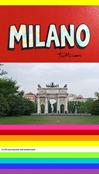
Milan is not merely a capital of fashion or business; it conceals an artistic heritage that puts many other European cities to shame. If you find yourself here, you will encounter world-renowned masterpieces—ranging from paintings and sculptures to unique historical documents and ancient artifacts. Here is the definitive guide to the absolute must-sees before you head home.
1. Iconic paintings: from Leonardo to Caravaggio
The undisputed king is undoubtedly Leonardo da Vinci’s *The Last Supper*, housed in the refectory of the Santa Maria delle Grazie convent. Along with the Sistine Chapel, it is the most famous fresco in the world; it depicts the precise moment Jesus announces that one of his apostles will betray him, capturing the emotions and drama etched on their faces.
Over at the Pinacoteca di Brera, the concentration of masterpieces is staggering. Here you will find Francesco Hayez’s *The Kiss*—the ultimate symbol of Italian Romanticism, which everyone has seen at least once in school textbooks—as well as Raphael’s *Marriage of the Virgin* and Andrea Mantegna’s dramatic *Lamentation over the Dead Christ*, famous for its revolutionary perspective viewed from the feet up. The gallery also houses Caravaggio’s *Supper at Emmaus*, a work where light plays a striking, cinematic role.
Among these iconic paintings is Raphael Sanzio’s *Marriage of the Virgin*, housed in the Pinacoteca di Brera.
This 1504 canvas is one of the most famous and significant paintings of the entire Italian Renaissance. Raphael painted it when he was just twenty-one, drawing inspiration from a composition by his master, Perugino, yet clearly surpassing him in terms of harmony, geometry, and a sense of space. The painting depicts the marriage of Mary and Joseph, with the main scene in the foreground and, in the background, a perfectly symmetrical, centrally planned temple dominating a vast, perspectively rendered piazza.
It is an absolute masterpiece, marking the precise moment when the young Raphael defined his ideal style—one characterized by grace, balance, and mathematical perfection. Standing before this painting inside the Pinacoteca di Brera (in Room XXIV) is an extraordinary experience: the precision of the details, the brilliant colors, and the illusion of depth captivate you instantly. It is one of those priceless works that alone makes the price of admission worthwhile.
Infine, al Museo del Novecento (affacciato su Piazza Duomo) c'è Il Quarto Stato di Giuseppe Pellizza da Volpedo, la gigantesca tela che raffigura la marcia dei lavoratori, e La città che sale di Umberto Boccioni, opera simbolo del Futurismo.
2. Historic statues: Michelangelo’s genius and antiquity
In terms of sculpture, the absolute masterpiece is the *Pietà Rondanini* by Michelangelo Buonarroti, which you can admire at the Sforza Castle (in the Spanish Hospital). It was the last sculpture the master worked on before his death; he never finished it, and it is precisely this raw, "incomplete" quality that conveys such incredible emotion and intimacy between the Virgin and Christ.
Also at the Sforza Castle, you will find Renaissance reliefs and monuments dedicated to the Sforza and Visconti families. If you head to the Gallery of Modern Art (GAM), you can find top-tier neoclassical and modern sculptures (such as those by Antonio Canova and Medardo Rosso), while in Piazza Affari stands the provocative contemporary sculpture *L.O.V.E.* by Maurizio Cattelan (the famous "Middle Finger").
3. Unique manuscripts: Leonardo and history
If you are a fan of historical codices and original drawings, a visit to the Biblioteca Ambrosiana (near Via Torino) is a must. This is home to Leonardo da Vinci’s *Codex Atlanticus*, the world’s largest collection of drawings, technical designs, maps, and notes by the Florentine genius. Seeing his sketches of flying machines and futuristic inventions in person is truly impressive.
The Ambrosiana also houses the *Ilias Picta*, one of the oldest illuminated manuscripts of the *Iliad*, dating back to the 5th century. If you are interested in the history of music and opera, the Museo Teatrale alla Scala and its adjacent library house original autograph scores by masters such as Giuseppe Verdi and Giacomo Puccini.
4. Archaeological artifacts: the origins of Mediolanum
To travel back in time to the Roman Imperial era, head to the Archaeological Museum of Milan (on Corso Magenta). Here you will find the spectacular Trivulzio Diatreta Cup—an exquisitely crafted, openwork glass vessel from the 4th century AD, considered one of the world's most precious examples of Roman glassmaking.
Also within the museum or the adjacent San Lorenzo area, impressive remains of the Roman walls and the Ansperto Tower are preserved. Nearby, the Basilica of Sant'Ambrogio houses the Golden Altar of Vuolvinio—a masterpiece of Carolingian goldsmithing adorned with gold, silver, and precious gems, which enshrines the relics of the city's patron saint.